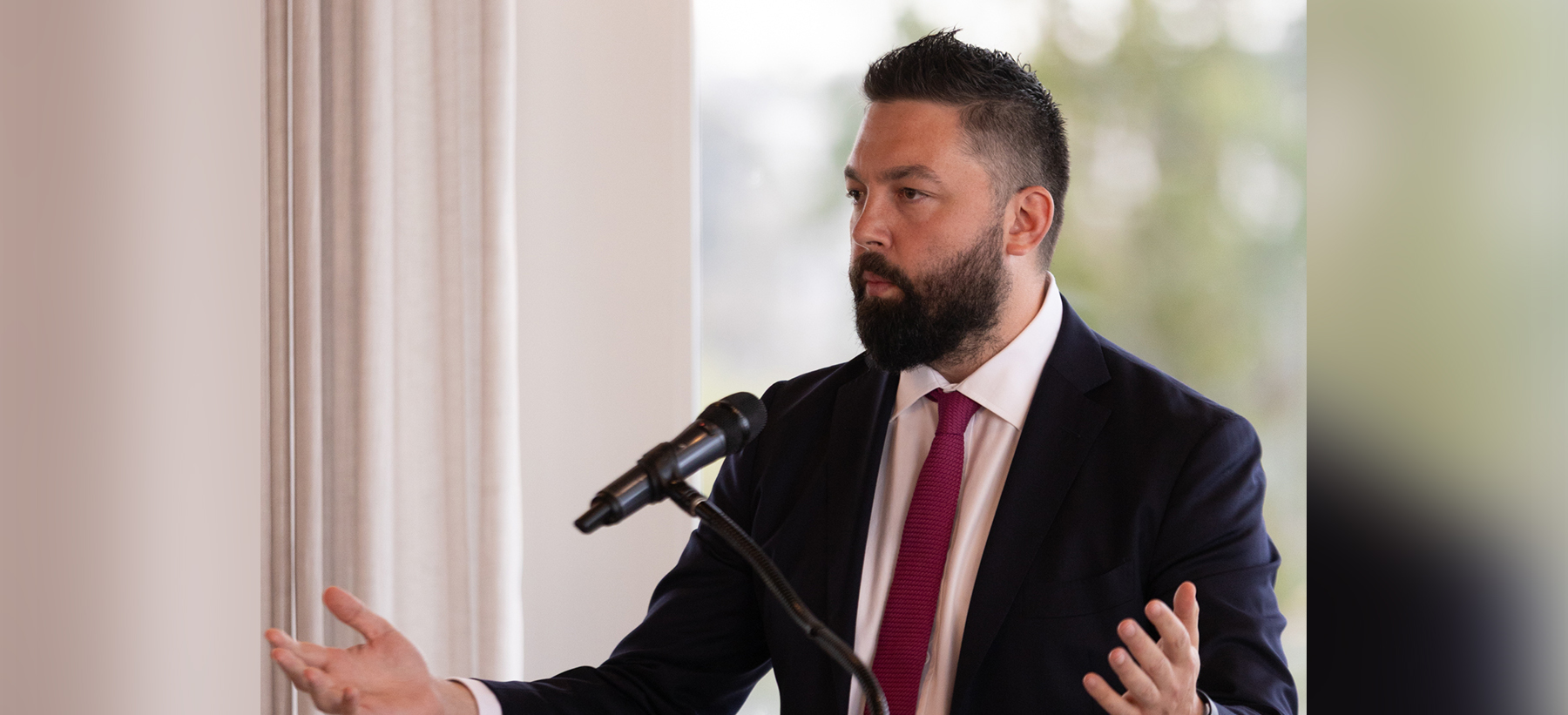
My leadership philosophy is simple: look after people, make the work clear, and do what you said you would do.
Proud Kamilaroi man Mitchell Bird began his career in the Australian Public Service (APS) through the Indigenous Apprenticeship Program after leaving school in Year 10. The program provided a pathway into the APS for First Nations Australians and marked the beginning of a career built on practical experience, continuous learning and leadership.
Sixteen years on, Mitchell is now a Director in the Department of Defence, and has added a Master of Entrepreneurship and Innovation at The Australian National University (ANU) to his education.
Driven by the same determination that has defined his career, Mitchell secured the Sir Roland Wilson Pat Turner Scholarship which enabled him to step away from his busy life and commit fully to his studies.
“I had built my career through practical experience, but I wanted to better understand the frameworks successful organisations use to work through complex problems, how innovation happens in challenging environments, and how leaders navigate uncertainty,” he says.
“The scholarship gave me the rare opportunity to step away from work and to immerse myself fully into study, undertake research connected to the public sector, and connect ideas with real leadership practice.”
Mitchell graduated with two Pat Turner Prizes – one for coursework excellence and one for his contribution to public policy research.
“The biggest shift was learning to see strategy as diagnosis, choice and coherent action, not simply a plan or a set of priorities. In complex environments, leaders often rush to activity because it feels like progress,” explains Mitchell.
“My studies reinforced that the harder and more important work is defining the problem clearly, making disciplined choices, and aligning people around action.”
“The combination of entrepreneurship and innovation has shaped my leadership: be clear about the problem, humble about the answer, and focused on bringing people forward together.”
The evolving landscape of leadership
For Mitchell, leadership is less about authority and more about creating the conditions for people and teams to succeed. He believes effective leaders provide clarity, support good decision-making and create environments where people can learn, grow and contribute at their best.
“I think emerging leaders most commonly go wrong when they see leadership as a title rather than a responsibility,” he says. “Great leadership is about listening carefully, making decisions when things are uncertain, owning mistakes, and creating the conditions for people to do their best work.”
While relinquishing control can be difficult, Mitchell sees it as essential to individual and team growth – even when mistakes are made.
“Not making a decision can sometimes be worse than making the wrong one, because if people become afraid of mistakes, effective decision making stops,” says Mitchell.
Having too narrow a definition of leadership, he argues, can undermine a leader’s value-based approach.
“Leaders need to be empowered to bring their real selves to leadership roles, because that is how trust is built, high-performing teams are sustained, and workplaces are created where people feel safe to fail, learn and grow.”
For Mitchell, cultivating a symbiotic dynamic with his team is central to well-rounded growth.
“I try to keep a learner’s mindset every day by asking what I can learn from the people around me, not just what I can teach them,” he says.
“My leadership philosophy is simple: look after people, make the work clear, and do what you said you would do.”
Carrying a Deadly legacy
Reflecting on his journey on the cusp NAIDOC Week and celebrating 50 years of Deadly, it affirms something unspoken but unwavering.
“The theme is a reminder to us all that First Nations excellence is not new. It has always been there – carried by people who had to create opportunities where none existed.”
He feels this profoundly in the context of his success with the Pat Turner scholarship.
“If we are to continue being deadly, I think those of us who have benefited from that legacy have a responsibility to guide, support and make space for emerging First Nations leaders.”
For Mitchell, his testamur carries a meaning that goes beyond personal achievement.
“I see it as a reminder of my responsibility to help mob in the APS thrive, lead and create opportunities for future generations,” he says. “I had mentors, leaders and community members who supported me and helped create opportunities along the way.”
“For me, the legacy is both personal and collective: carry the responsibility well, and make the path wider for those who come next.”
A message to future scholars
Mitchell’s journey adds another story to the anthology of people who did not follow the traditional route.
“You do not need a perfect pathway or a traditional academic background to become a Pat Turner Scholar,” he says. “Use the scholarship as more than a qualification – use it to think deeply, build relationships, test ideas and grow your confidence.”
“Most importantly, learn more about yourself.”
The ANU College of Business and Economics offers an extensive range of specialised programs. Click here for more details.
Image credit: Tim Rendall/CBE
You may also like

Relationship building with the Australian Public Service recognised
CBE’s Carlyn Waters awarded Ian Castles Alumni Prize for her outstanding efforts to build productive relationships between the College, the University and the APS.

2023 Indigenous Business Month: To gather, together
Wiradjuri woman and ANU alumna Leila Smith shares her study and career journey, and offers invaluable advice to up-and-coming Indigenous students.

A lifetime of advocacy leads CBE alumnus to Oxford University
Rhodes Scholar recipient Sam Watson makes plans to pursue his interest in the intersection of business and climate policy.