Only seven countries across the world have as many or more women than men serving in their national parliaments.
Australia, despite being closer than ever to gender parity in politics, isn’t one of them.
The House of Representatives is currently made up of 68 women and 82 men, placing our country ninth globally in the latest United Nations’ Women in parliament ranking.
While Australia and other countries have made steady gains in women's political representation, many others are lagging behind.
“Progress has been uneven across the world,” says Dr Samira Nazar, a researcher at The Australian National University (ANU) College of Business and Economics (CBE).
“Places like Hungary, Japan, and Turkey, where women hold less than 20 per cent of parliamentary seats, show how fragile it can be.”
With 2030 approaching, the United Nations’ Sustainable Development Goal 5 – aimed at achieving gender equality – is nearing its deadline.
But globally, women hold only 26.9 per cent of parliamentary seats despite making up 50 per cent of the world’s population.
“We are not on track,” Samira says. “The World Economic Forum projects that full gender parity in political life is still beyond the reach of another five generations at the current pace.”
“Democracy is premised on the idea that government reflects and responds to the people it governs. When half the population is systematically excluded from political decision-making, that premise is undermined.”
The ANU researcher explains the stark divide between countries comes down to one key factor: the strength of their accountability institutions.
Recently, Samira has joined forces with Dr Ashkan Zarghami, an associate professor of Project Management at CBE, to investigate how government accountability can enhance women’s political representation and leadership opportunities.
A synergistic solution
Excluded from political life until the mid‑19th century, women have in recent decades gained ground in the halls of power thanks to developments such as the adoption of gender quotas.
Despite a proliferation of measures designed to narrow the gender gap, Samira and Ashkan say no reform is sufficient on its own.
Drawing on evidence from 30 Organisation for Economic Co-operation and Development (OECD) countries, their recent study shows women’s political representation is strongest when multiple accountability mechanisms operate together.
“Most research looks at one factor at a time, such as elections or civil society and asks whether that factor helps women enter politics. We took a different approach because real-world systems do not work in isolation,” Ashkan says.
The researchers examined three forms of accountability and their interactions:
- Vertical: citizens holding governments to account through competitive elections, political parties and access to official information.
- Diagonal: driven by non-state actors such as independent media and civil society organisations holding government to account.
- Horizontal: state institutions with systems of checks and balances, such as independent supervisory bodies, the rule of law, and legislatures holding the executive branch accountable.
“Each of these forms can enable, amplify or hinder the others depending on the context. What is needed is a balanced configuration of all three,” says Samira.
“For example, quotas without electoral integrity can be circumvented and media freedom without civil society to act on information has limited impact.
“The key contribution of our paper is that no single mechanism is sufficient. Women’s political representation can only emerge from synergistic configurations of interdependent accountability structures operating together.”
This close interdependence, as the researchers explain, suggests there is no universal blueprint for success.
“We found at least three distinct pathways, and countries with different institutional strengths and weaknesses can reach the same goal through different combinations,” says Samira.
“This means policymakers don’t need to build a perfect comprehensive system from scratch. You can identify which mechanisms your context already has and build strategically around them.”
Four necessary conditions
Although countries such as Australia, France and Poland have achieved higher levels of women's political representation through different pathways, the CBE researchers identified four features shared across all of them: high-quality elections, media freedom, strong civil society organisations and effective supervisory bodies.
Ashkan says these four conditions are essential to foster women’s political leadership.
“When elections are competitive, credible and inclusive, women have a better change of entering politics,” he says.
“Similarly, media shapes public perceptions of leadership, so when women receive fair visibility and stereotypes are challenged, political participation becomes more accessible.
“Civil organisations are also essential. Historically, many advances in women’s political participation have been driven by civic movements rather than governments acting alone.
“Lastly, independent supervisory bodies matter because rules alone rarely create change unless someone monitors and enforces them.”
Can we sustain progress?
The hard-won progress in women’s political representation should never be taken for granted.
Amid signs of democratic backsliding in countries such as Australia and the United States (US), Samira and Ashkan caution that OECD nations risk stalling – or even reversing – the gains if they become complacent.
“Governments experiencing democratic erosion consistently move first to restrict civil society space and media freedom – two of the four necessary conditions to foster women’s political representation,” says Samira.
The CBE researchers say early warning systems and international accountability networks are of critical importance to sustain progress.
“International actors, regional bodies, and domestic institutions should establish monitoring frameworks that holistically and continuously track both informal governance configurations, such as civil society autonomy, and formal ones, such as electoral integrity,” she says.
“Where domestic accountability is weakening, international bodies such as the United Nations (UN) can provide external pressure and legitimacy for accountability standards.”
Similarly, the researchers urge policymakers to remain alert to those governments trying to resist change.
“Those who benefit from existing exclusionary systems will resist any reforms,” says Samira.
“A political economy analysis, such as understanding who has interests in maintaining the status quo and what leverage exists to shift those interests, is an essential complement to any governance reform agenda.”
Lessons for Australia
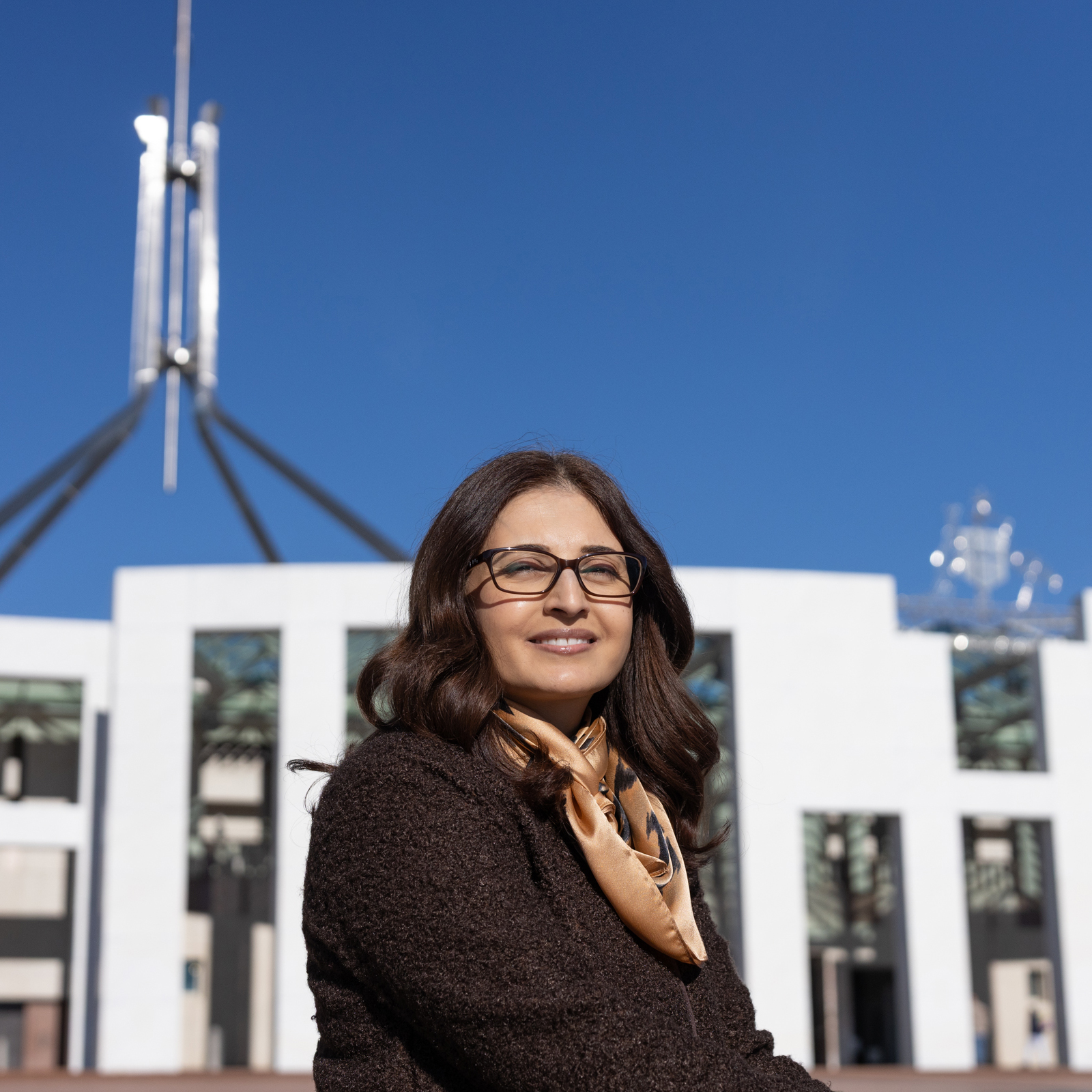
Dr Samira Nazar outside Parliament House in Canberra. Image credit: Tim Rendall/CBE
While Australia performs strongly across most of the accountability dimensions, there is one area where, comparatively, it isn’t up to par with other advanced democratic countries: access to official information.
“Our analysis shows government transparency mechanisms are a ‘don’t care’ condition in Australia that is compensated by the strength of other mechanisms such as electoral integrity and legislature effectiveness,” says Samira.
“Improving government transparency and making public information easier to access for citizens, media, and communities is key to better track progress and hold decision-makers accountable for gender equality commitments,” says Ashkan.
Image credit: Tim Rendall, CBE
You may also like

RSA graduate wins 2026 AFAANZ Best PhD Award
Dr Simeng Liu, a graduate of the ANU College of Business and Economics (CBE) Research School of Accounting (RSA), has won the 2026 Best PhD Award from the Accounting and Finance Association of…

Why do so many organisations fail to implement their strategies?
Professor Ofer Zwikael’s new book is essential reading for leaders trying to turn their strategic vision into impact.

The common root: how unequal earnings could be fuelling racial wealth and crime disparities
New ANU research suggests that racial wealth and crime gaps in the United States share a common driver, and how understanding this connection could lead to better policymaking.